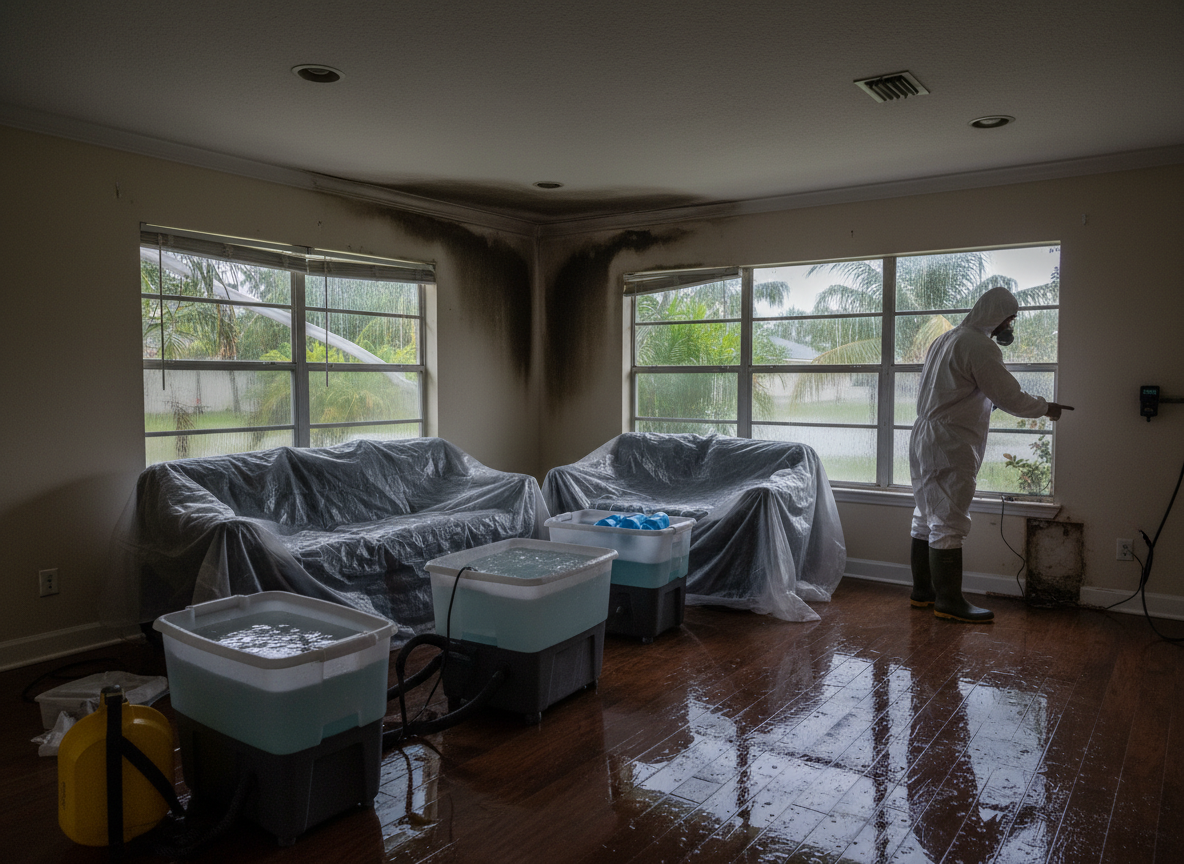
Golden Lakes is a community of condos, villas and low-rise buildings where a leak in one unit rarely stays in one unit. Shared walls, shared plumbing and part-year occupancy mean water can travel quietly between addresses before anyone reports a smell. This page explains what we look for at a Golden Lakes address.
What should a Golden Lakes owner know about water damage?
The building matters as much as the unit. Golden Lakes is an unincorporated community in the 33411 ZIP, and its main address is Golden Lakes Village, a 55-plus community of about 1,888 condos, villas and homes built in two phases in the 1970s and 1980s. In that kind of building, a supply line or a condensate pan inside one unit can wet a shared wall, a common corridor or the unit below.
Because the community is unincorporated, there is no city building department to call. Palm Beach County handles permits, and the association handles access, common elements and work rules. Knowing which is which is the first practical step.
What shapes water damage in Golden Lakes?
Four local facts explain most of the work here: the two-phase 55-plus development, the shared construction, the part-year occupancy pattern and the split between county and association responsibility.
A 55-plus community built in two phases
Golden Lakes Village was developed in two sections. Phase A, the larger part, dates from the mid-1970s and is made up mainly of condo units in low-rise and duplex-style buildings. Phase B came in the 1980s and added villas and single-family homes, including about 800 residences in the unincorporated area near the Okeechobee Road exit of the Florida Turnpike. The two phases have different roofs, different plumbing layouts and different associations, and a water problem in one does not follow the same path as the other.
Shared walls, shared pipes and association rules
A condo or villa shares more than a wall. Plumbing risers, common-element lines, roof areas and exterior envelopes may belong to the association, while fixtures and finishes inside the unit usually belong to the owner. When water crosses that boundary, the first task is documentation: where it entered, which side of the boundary the failure is on, and what the readings show. The association may also control work hours, corridor protection, elevator use and whether a vendor can work without a manager present.
Part-year occupancy and closed units
A large share of Golden Lakes residents live here for part of the year, and a unit that is closed for the summer is a still, warm, humid box. The air conditioning may be set high or off, the water may be shut off at the fixtures but not at the riser, and nobody is there to notice a weeping valve or a condensate overflow. By the time the owner returns, the cabinet base and the wall behind it can have been damp for weeks, and the smell is the first evidence.
Who serves the address
Golden Lakes is unincorporated Palm Beach County, so building permits and inspections go to the county rather than a city. The condominium or homeowners association controls common elements, access and work rules, and the association's documents decide who repairs what. Fire rescue and law enforcement are county services. For a water job, that means two conversations: one with the county about the permit, and one with the association about access and the boundary. The two phases also age differently. A mid-1970s condo block may have original drain lines and a roof that has been repaired in sections, while a 1980s villa may have a different envelope and a newer water heater. Knowing which phase a unit is in tells us what to look at first.
What does a Golden Lakes unit need from us?
A Golden Lakes unit needs the water traced through the building, not just mopped inside the front door.
When water has entered from a supply line, a condensate overflow, a roof or a storm opening, water damage restoration covers water removal, extraction, storm damage and leak detection. In a shared building, the wet boundary often extends into a common wall or the unit below, and the readings have to be taken on both sides before anyone decides what belongs to whom. We document the boundary and dry against the readings.
When a wall, cabinet or ceiling has stayed damp long enough to smell, mold damage restoration is the next step. Containment matters more in a condo than in a detached house, because the work area shares air with neighbouring units and a common corridor. We seal the openings, protect the route and filter the air so the rest of the building is not part of the work zone.
We also separate the unit work from the association's common-element repair. If the source is a riser, a roof or a common line, the association is involved, and we will name that rather than opening a wall that is not ours to open. Before anything is opened, we photograph the unit side and the common side of the wall and record the readings at both. If the failure is in a common element, that record is what lets the association's contractor and the unit owner work from the same facts instead of two versions of events.
Why use us in Golden Lakes?
Because a shared building needs a paper trail as much as a drying plan. We work from 12841 Meadow Breeze Dr in Wellington, about seven miles from Golden Lakes, and we ask about access, the association and the unit's shutoff before the visit. We record readings on both sides of a shared wall, name the trade or association that owns a repair, and put the scope in writing. We publish only the facts this business has supplied. A part-year unit also has a different failure pattern from a full-time home: a small leak is not noticed and reported in a day, so the material has more time to stay wet. That is why we ask how long the unit has been closed before the visit.
Why does a Golden Lakes leak get worse quickly?
Because a closed unit in a South Florida summer does not dry. Relative humidity stays high for most of the year, and an unoccupied condo with the air conditioning off is a warm, still space where a damp cabinet base stays damp. Growth can begin on a damp surface in about a day or two, and a slow leak has weeks to work before anyone opens the door.
The building adds to it. Water in a shared wall can travel sideways into a neighbouring unit or downward into the unit below, so a small leak can become a multi-unit problem. The plumbing in a 1970s or 1980s building is also at the age where supply lines, shutoff valves and drain connections begin to fail, and a part-year owner may not be there when they do.
How does a job in Golden Lakes run, step by step?
- Call and access check. Tell us the building, the unit and whether an association manager needs to be involved. We confirm access before the visit.
- Read the unit and the boundary. We read the wall bases, cabinet floors and ceiling, and check the shared wall or the unit below where the water may have travelled.
- Write the scope. The scope separates the unit work from common-element repairs and names the association where relevant.
- Remove and extract. Standing water, saturated material and water held in cabinet bases come out.
- Dry against readings. Equipment runs at marked points, with corridor protection and work-hour limits respected.
- Verify and hand back. Final readings are compared with day one, and the record names any other trade or association repair.
What's included in a Golden Lakes job
- A moisture survey of the unit and the shared boundary
- Corridor and common-area protection during the work
- Extraction of standing water and removal of saturated material
- Containment and air filtration where growth is disturbed
- Drying equipment positioned against marked readings
- A written record of readings before and after
- A named hand-off for plumbing, roofing, association or rebuild work
Which nearby areas do we cover from Golden Lakes?
Royal Palm Beach, Lake Belvedere Estates, Royal Palm Estates, Greenacres and Wellington are all within about ten miles of our Wellington base, and we cover each one. The condo and villa pattern is strongest in Golden Lakes; the neighbouring communities are more mixed, and each has its own page. In a shared building, the adjoining unit is part of the assessment. Water that leaves a cabinet base can cross a party wall or follow a pipe penetration into the unit below, and a scope that stops at the front door can miss half of the loss.
What should you do next?
Call (561) 960-0937 and tell us the building, the unit, where the water appeared and whether the association needs to be notified. If a ceiling is bulging or water is near a panel, keep the area clear. We cover Golden Lakes from our base at 12841 Meadow Breeze Dr in Wellington.
A contained removal also protects the neighbouring unit, which shares the same air and often the same wall cavity.
The documentation matters if the association and an insurer are both involved, because both need to see the same readings rather than two different descriptions of the same room.
The building also holds heat differently from a detached house. A mid-rise block with concrete walls and a shared roof can stay warm overnight, and a unit with the blinds closed and the system off can hold moisture against the wall for longer than the weather outside would suggest.
A leak that crosses a unit boundary can also involve two owners and one association, which is why the readings and photographs are taken before anything is moved. In a part-year community, the calendar is part of the risk: a leak that starts in June may not be reported until November, and the material has had a whole wet season to sit.
Around Golden Lakes
We regularly work near:
- 📍Golden Lakes Village
- 📍Lake Susan
- 📍Okeechobee Boulevard
Water Damage Restoration in Golden Lakes — Local Notes
- •Unincorporated Palm Beach County, ZIP 33411.
- •55-plus condo and villa community built in two phases.
- •About 1,888 residences in Golden Lakes Village.
- •Shared walls, common elements and association rules.