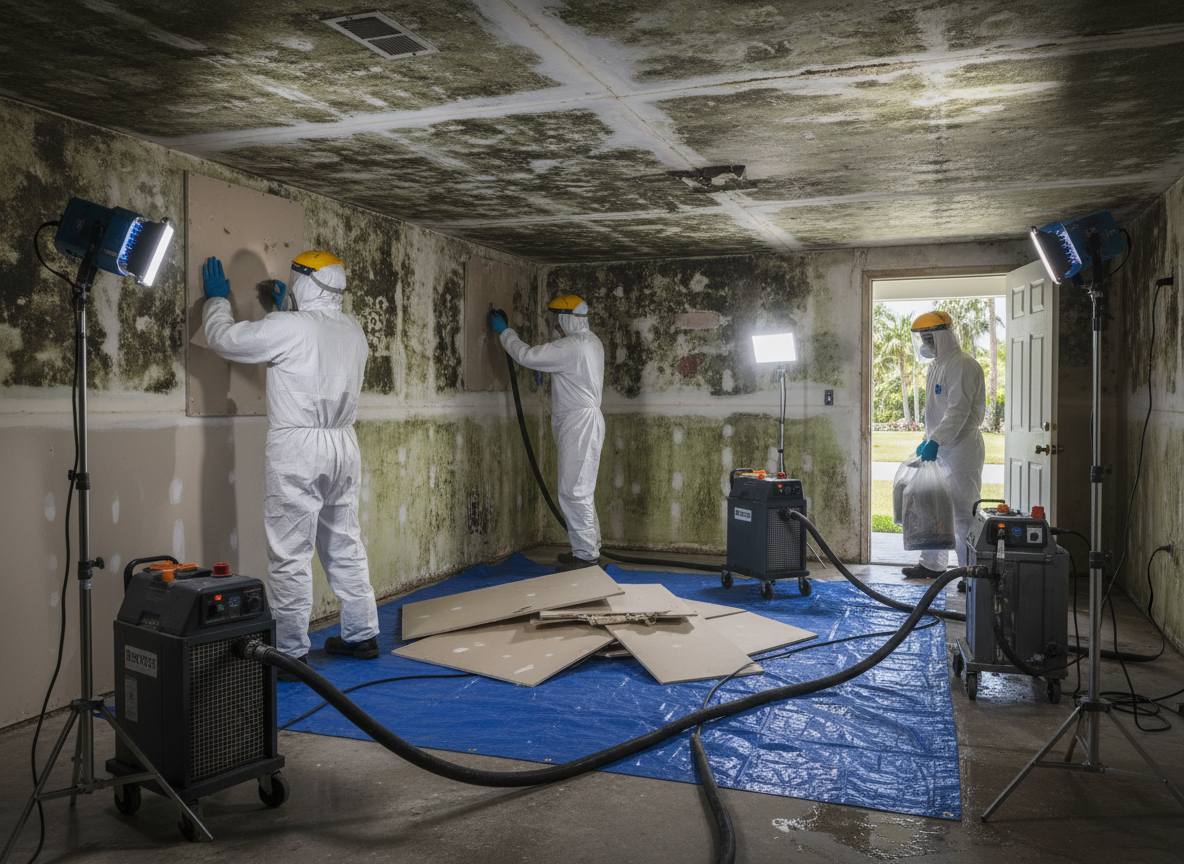
Mold damage restoration in Wellington often begins with a smell rather than a stain. A tack room that smells musty when the doors are shut, a guest room that only smells when the air conditioning runs, a closet behind a bathroom, or a cabinet toe kick that has darkened: the growth is usually on the back of a material that stayed damp after a leak everyone thought was fixed. The work is to find the moisture that is still there, contain the area, remove what cannot be saved and correct the source.
What mold damage restoration covers in Wellington
Mold is a symptom. Cleaning a visible patch without finding the water is the reason it comes back, and it is the most common problem we are asked to correct. Our work is built around four decisions: where the moisture is coming from, how far the growth extends, what has to be removed, and how the area will be verified before it is closed up.
The moisture source is identified first. A bathroom exhaust that discharges into the attic, a supply line that dripped behind a vanity, a window track that holds rain, a condensate pan that has been overflowing or canal water that soaked a bottom plate all leave different evidence. We find the source before containment goes up, because remediation without correction is a temporary result.
The work area is contained before anything is disturbed. Disturbing growth without containment can move spores through a house, especially when the air conditioning is running. We seal openings, protect the route and filter the air so the rest of the home is not part of the work zone.
Material is removed, not painted over. Porous material that has supported growth, such as drywall paper, insulation, carpet pad and some cabinet board, cannot be cleaned back to a sound state. We remove it, bag it and dispose of it, and we tell you what is being removed before it comes out.
The scope is written and the hand-off is named. A bathroom fan that vents into the attic needs a roofer or an HVAC contractor. A failed supply line needs a plumber. A wall that has to be rebuilt needs a general contractor. We name the trade in writing rather than implying we cover it.
No health claims. We are not physicians and we do not diagnose illness. If you have a health concern tied to a damp building, that conversation belongs with your doctor. Our job is the building: find the moisture, remove the affected material, dry the assembly and leave a record.
Why a damp Wellington wall does not dry on its own
Wellington does not offer many dry weeks. Relative humidity stays high for most of the year, air conditioning keeps interior surfaces cool enough to condense moisture, and the rainy season runs through the same months as hurricane season. A wall cavity that is damp in June is unlikely to dry on its own in July. Growth can begin in about a day or two on a damp surface, and a closed house with the system off can support it faster.
The village's water management makes the ground part of the story. Wellington was drained for agriculture before it was developed, and the Acme Improvement District still manages roughly 86 miles of canals, about 978 acres of lakes and eight pump stations. That system keeps the water table managed, not absent. In a wet season the soil stays close to saturation, a canal can rise against a seawall, and a slab or a wall base that is already damp has nowhere to dry into.
The seasonal pattern makes it worse. Some Wellington homes and a large share of the condos to the east are not occupied year-round. A unit that is shut up for the summer with the air conditioning set high, the water off at the fixtures but not at the riser, and the blinds closed is a still, warm, humid box. A slow supply-line weep or a condensate overflow in that unit has weeks to work before anyone opens the door. By the time the owner arrives, the smell is in the bedding and the wall behind the headboard.
Waiting also changes the scope. Growth confined to one side of a wall may mean removing a section of drywall and insulation. Left through a wet season, the same moisture can reach the wall cavity, the cabinet run and the floor assembly, and the containment grows with it. The cost is not only the remediation; it is the material, the contents handling and the time the room or the barn cannot be used.
The facts we can stand behind
Mold Damage Restoration Wellington works from 12841 Meadow Breeze Dr, Wellington, FL 33414, in Palm Beach County. The phone number is (561) 960-0937, and it reaches the same business shown in the footer of every page.
The services are two: water damage restoration, which includes water removal, water extraction, storm damage and water leak detection, and mold damage restoration, which is this page. Mold work covers containment, removal of affected material and correction of the moisture source where growth is visible or a cavity has stayed damp. It does not include clearance testing, medical advice or reconstruction.
The areas are Wellington and eight Palm Beach County communities within about ten miles: Loxahatchee, Loxahatchee Groves, Royal Palm Beach, Golden Lakes, Lake Belvedere Estates, Royal Palm Estates, Greenacres and The Acreage. The housing differs enough that the area pages are written separately, because a barn tack room, a 1980s canal-lot house and a 55-plus condo fail in different places.
We publish only the facts this business has supplied. We also do not claim that a remediation is passed or cleared by an authority we do not have. If your association or insurer requires independent clearance testing, we will tell you that it is a separate specialist service and help you plan around it.
A tack room, a closed condo and a house with a big air handler
Wellington's mold work tends to cluster in three situations that a generic page does not describe.
The first is the equestrian property. A barn is a damp building by design: wash racks, hose bibs, troughs, feed rooms, tack rooms and a concrete floor that is hosed down. Leather, feed and bedding hold moisture and odour, and a tack room is often closed up with no air movement. A supply line to a wash rack that weeps behind a wall, a roof panel that lets rain onto a hay loft, or a trough float that sticks and overflows can keep one corner of a barn wet for weeks. The house may be perfectly dry while the tack room smells of mildew, and the two need to be read as separate buildings with separate shutoffs.
The second is the part-year condo, especially in the 55-plus communities to the east. A unit closed for the summer with the air conditioning running high and the water on at the riser is a humid box with cool surfaces. Condensate, a weeping valve or a slow line under a vanity can support growth in the cabinet base and the wall behind it before the owner returns. Shared walls and common elements mean the boundary between unit and building has to be documented before anyone opens a cavity.
The third is the large newer house. A big air-conditioned volume produces a lot of condensate, and the air handler is often in a closet, a garage or a second-floor mechanical room where an overflow is invisible until it reaches a ceiling below. Add a laundry closet, an ice maker line and a pool equipment pad, and the moisture can start in a place nobody associates with the room that smells. In a tight house, the smell often shows up in the room farthest from the source because the return air carries it there.
Where mold starts in Wellington buildings
Four locations account for most of the mold work we are asked to scope here. Each is a moisture problem with a building cause, not a cleaning problem.
A bathroom exhaust that discharges into the attic
The component is the exhaust fan, its duct and the termination. In older Wellington houses the fan runs, the ceiling stains, and the duct either stops in the attic or is disconnected at the roof cap. What you notice is peeling paint at the bathroom ceiling, a musty smell in the hallway or condensation on the mirror that never clears. The first move is to check where the duct actually goes, from the attic if it is accessible, and to stop using the fan until it is corrected. The termination is a roofing or HVAC repair; the remediation of the damp ceiling and framing is ours. A duct that ends in the attic also moves warm, wet air into a space that has no ventilation of its own.
A supply line weeping behind a vanity
The component is the braided line, the shutoff valve and the drain trap inside a vanity cabinet. These fail slowly, and the cabinet floor holds the water against the wall base. What you notice is a dark stain on the cabinet floor, a soft toe kick, a smell when the doors are opened or paint lifting on the wall behind the vanity. The first move is to shut the valve, empty the cabinet and leave the doors open so the area can be read. The plumbing repair belongs to a plumber; the cabinet assessment, containment and drying are ours. A slow weep can also travel along the cabinet base and reach the wall on the far side of the vanity.
An air-handler closet with a clogged condensate pan
The component is the air handler, the coil, the primary drain, the secondary pan and the float switch. In Wellington the system runs almost continuously, so the coil produces condensate every day. What you notice is a musty smell at the supply registers, a rust ring on the platform, water on the closet floor or a stain on the ceiling below. The first move is to switch the system off and check the pan and float switch before it runs again. The drain correction is an HVAC repair; the damp closet, insulation and ceiling are ours to contain and dry. A pan that has overflowed more than once usually means the drain line, not the pan, is the problem.
A window track that has held rain since the last storm
The component is the window frame, the track, the weep holes and the flashing above the opening. Wind-driven rain enters where the track drains poorly or the flashing has failed, and the water sits in the wall below the sill. What you notice is a soft sill, bubbling paint, a musty bedroom or a stain that appears only after a storm from a particular direction. The first move is to photograph the interior and exterior, clear the weep holes if they are blocked and stop using the window until the opening is repaired. The envelope repair belongs to a window or roofing contractor. A track that holds water also keeps the wall below it damp, even when the room looks dry.
How mold damage restoration runs in Wellington, step by step
The sequence is designed to keep the rest of the house out of the work zone and to make the end point measurable.
- Assess and find the moisture. We read the affected rooms and the assemblies around them with meters and thermal imaging, and confirm whether the source is still active.
- Write the scope. The scope names the material to be removed, the containment, the air filtration and any repair that belongs to another trade.
- Contain the work area. Openings are sealed, the route is protected and the containment is put under negative pressure where the work warrants it.
- Remove affected material. Porous material that has supported growth is removed, bagged and disposed of; surfaces that can be cleaned are cleaned.
- Dry and verify. The cavity is dried against readings, and the final numbers are compared with the day-one record before the containment comes down.
- Hand back with a record. You receive the photographs, the readings and a written note of what was removed, what was cleaned and which repair belongs to another trade.
What's included in mold damage restoration
- A moisture assessment of the affected rooms and surrounding assemblies
- Containment of the work area, including openings and the route
- HEPA filtration and negative pressure where the scope requires it
- Removal and bagged disposal of material that cannot be saved
- Cleaning of surfaces that can be saved
- Drying of the cavity against recorded readings
- A written record of what was removed, cleaned and read
- A named hand-off for plumbing, roofing, HVAC or rebuild work
What is not included
- Independent clearance testing or laboratory analysis
- Medical advice or diagnosis
- Reconstruction of removed drywall, cabinetry or trim
- Work on common elements that the association controls, without the association's approval
Questions Wellington homeowners ask
How do I know if it is mold or just a damp smell? A smell tells you there is moisture, not necessarily what is growing. The useful next step is to find the water: read the wall base, the cabinet floor, the ceiling and any concealed cavity, and confirm whether the source is still active. If growth is visible, the material and the extent decide the scope. We do not diagnose from a photograph, and we do not treat a smell as a reason to remove a wall without a reading.
Can you remove mold without taking out the drywall? Sometimes. Growth on a painted or sealed surface can be cleaned if the material is sound and the moisture source is corrected. Growth on drywall paper, insulation, carpet pad or bare wood is a different matter, because those materials hold moisture and cannot be cleaned back to a sound state. The readings and the material decide it, not a general rule.
Will the mold come back after remediation? It can, if the moisture is not corrected. Remediation removes the growth and the material that supports it; it does not stop a leaking valve, a roof opening or a condensate line that is still overflowing. That is why the scope names the source and the trade that owns the repair. Correct the water and keep the assembly dry, and the conditions for growth are gone.
Do you provide clearance testing or a certificate? No. Clearance testing is an independent specialist service, and we do not present our own work as verified by it. If your association, insurer or a prospective buyer requires a clearance letter, we will tell you that at the outset and plan the sequence around an independent tester. We provide the photographs, readings and written record of what was removed and dried.
Is it safe to stay in the house during remediation? It depends on the size and location of the containment. A single bathroom or closet can often be worked on with occupants in the rest of the house while the work area is sealed and filtered. A larger removal, or work involving the air handler or a shared corridor in a condo building, may mean staying out of the work zone and sometimes out of the unit for the day. We explain the plan before containment goes up.
How long does a mold remediation take? A contained bathroom or closet is usually a matter of days, while a larger assembly that includes a wall cavity, cabinetry and drying can take longer. The removal is the fast part; the drying and verification set the end point. We give you the readings-based sequence rather than a fixed date, and we tell you when the containment can come down.
Do you handle the reconstruction after the material is removed? We remove and dry; reconstruction is a separate trade. We can tell you what has to be rebuilt and leave the written scope for the contractor who does it, but we do not present ourselves as the builder. If the repair is small and inside our scope, we will say so; if it is not, we will not stretch the description.
What should I do while I wait for the visit? Stop the water if you can do so safely, keep the area closed off, and do not run fans that could spread dust or spores through the house. Do not paint over a damp patch or apply a household treatment to a porous surface; both make the assessment harder. Photograph what you see, note when the smell is strongest, and leave the area undisturbed until it has been read.
What to do next
Call (561) 960-0937 and describe where the smell is strongest, what the room looked like after the last leak and whether the space has been closed up. If a wall or ceiling is soft, keep the area clear and do not disturb it. We work from 12841 Meadow Breeze Dr in Wellington and cover the village plus eight Palm Beach County communities within about ten miles.
How it works
- 1
Assess and find the moisture
Read the rooms and assemblies, and confirm whether the source is active.
- 2
Write the scope
Name the material to be removed, the containment and any repair that belongs to another trade.
- 3
Contain the work area
Seal openings, protect the route and filter the air.
- 4
Remove and clean
Porous material that supported growth comes out; sound surfaces are cleaned.
- 5
Dry and verify
The cavity is dried against readings before containment comes down.